
Our Business
Business Introduction

Business Introduction
We are developing our business on two fronts: technology development and product development support, with the aim of accelerating the practical application of "new hydrogen fusion." We are advancing the development of a groundbreaking prototype that generates heat for extended periods with minimal hydrogen consumption by improving the performance of nanocomposite metal materials and optimizing reactors. Furthermore, we will provide this innovative heat generator to our partner companies and aim for the practical application of the final product through joint development. Let's create the next generation of clean energy society together.

Technology development
- Heat-generating materials (improved performance suitable for practical use of nano-composite metal materials)
• Reactor (configuration and control methods that utilize reaction characteristics in collaboration with development partner companies)
- Working prototype (conducts a novel hydrogen fusion reaction)
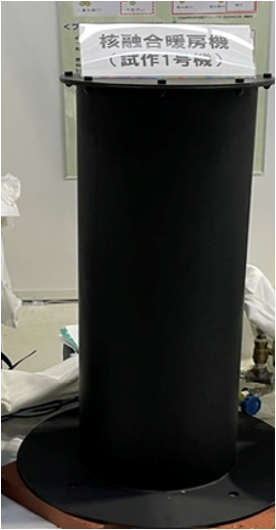
(A prototype device that allows you to experience prolonged heat generation with almost no power consumption.)
Our Technology
Technical Introduction
What is new hydrogen fusion?
This is a novel nuclear fusion reaction of hydrogen generated under specific conditions involving nano-composite metal materials and hydrogen. It is a new technology developed from so-called cold fusion research and is also called condensed matter fusion.
Recent research advancements have confirmed its reproducibility, and the heat output has also increased. This is a dream technology that is eagerly awaited to be put into practical use as a new energy source that could be a groundbreaking and realistic solution to global energy problems and carbon neutrality.
The high-temperature nuclear fusion of hydrogen produced in the sun requires hundreds of millions of degrees Celsius and tens of thousands of atmospheres of pressure, and to recreate this reaction on Earth would require massive reaction facilities. Furthermore, it presents problems of radiation shielding and nuclear waste disposal. Our new hydrogen nuclear fusion can be achieved at temperatures below 1,000 degrees Celsius and hydrogen pressures of a few atmospheres, generating heat with an energy density more than 6,000 times greater than chemical reactions such as hydrogen combustion where hydrogen and oxygen turn into water, without producing radioactivity or nuclear waste. It is a dream new energy source that is eagerly awaited.
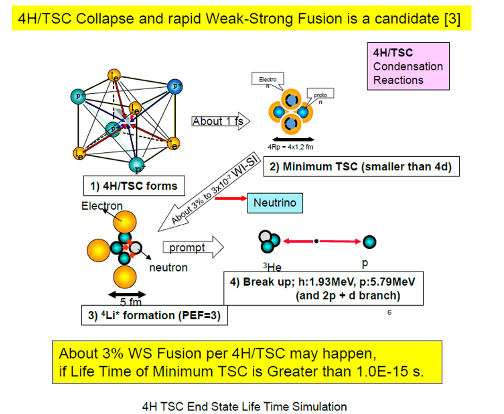
The 4H/TSC theory predicted the production of helium-3, which is almost nonexistent on Earth, through nuclear fusion reactions.
The formation of helium-3, proportional to the amount of heat generated, was measured using the NRA (Nuclear Reaction Analysis) method, and the results were published in the Journal of the Japan Society of Applied Physics after peer review (February 2025).


Features
- It reacts with minute nickel metal particles in the composite powder (no precious metals are required). - It uses light hydrogen gas as fuel and generates 1 kW of heat per 1 kg of powder material. - It generates a thermal output of more than twice the input power, enabling stable, long-term heat generation. (The target for practical use is a thermal output of more than 10 times the input power.)
• Heat generation and temperature can be easily controlled.
• It can operate stably in the temperature range of 400-1000°C, which is typical for industrial equipment. • There is theoretically no radiation emission. Measured values will not exceed naturally occurring levels.
Since the amount of light hydrogen consumed is extremely small, long-term, self-sufficient operation on a yearly basis is possible.

Our Business
